Teaching and Learning
Teaching and Learning Detail
- All lessons at RFSS begin with a review of previous work: the SET (Silence Equipment Task) for learning. This “SET” recall task draws on research from Ebbinghaus’s Forgetting Curve and Sweller’s Cognitive Load Theory. The process of teaching new material follows the guidance of Rosenshine’s Principles of Instruction, the Great Teacher Toolkit and Lemov’s Teach Like a Champion.
- New material is taught in small steps using clear models and examples (“I do”).
- Guided practise occurs (“We do”).
- Time is allowed for meaningful, scaffolded independent practise (“You do”).
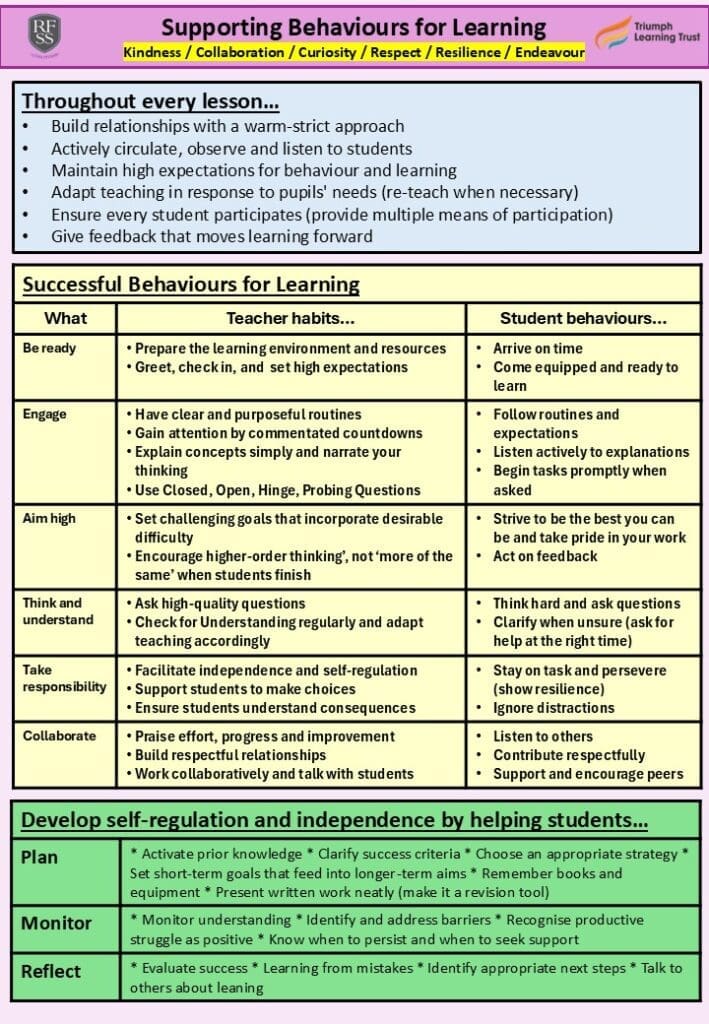
- Albert Bandura’s Social Cognitive Learning Theory and the EEF’s Metacognition and Self-Regulated Learning guide provide a research foundation for RFSS’s belief that lessons should nurture relationships for learning, create supportive learning environments, develop self-regulating learners, develop literacy, achieve a high success rate, pause lessons where appropriate to re-teach, use AfL to check for understanding, and provide appropriate feedback.
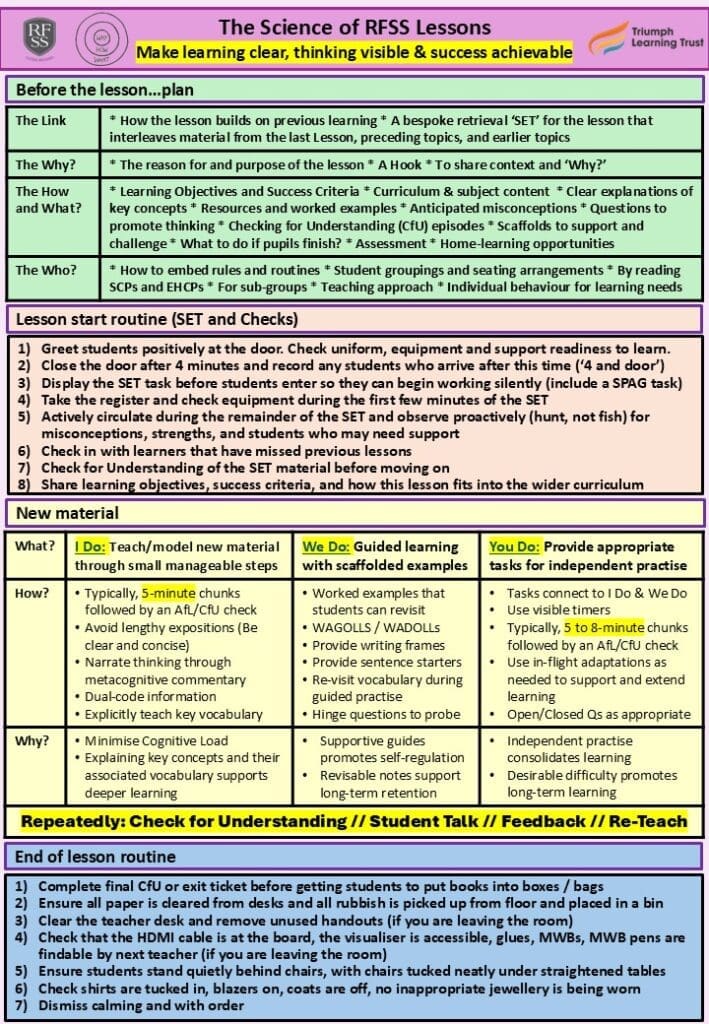
SET For Learning: ‘SET’ stands for ‘Silence, Equipment, Task’ and puts the onus on to the student to be ready and prepared for their lesson. Students should begin the lesson in silence, and should begin work on a task displayed by their teacher.
Memory: Linked to SET For Learning, students should be given the opportunity to develop their memory recall and retrieval skills, at the start of each lesson. This could take the form of a Do Now Activity, or an Image-Based task. Students should work on this individually and in silence, unless directed otherwise. This task should be linked to previous sequential learning, or where appropriate, should be linked to previous units (interleaving).
Making Links: Students need to be able to recognise how the learning in one lesson relates to learning in previous lessons, in order to create sequences of learning and to build schemata. As a result, lessons should refer to previous learning and should also be contextualised as to their purpose, and to their place in the real world.
Talking Points: Students should be given the opportunity to discuss their ideas in pairs and in groups, in order to shape perspectives and form appropriate opinions. Students should be encouraged to add to, build on, or challenge the ideas of their counterparts. Talking Points can also be the stimulus for a piece of extended writing or written work.
Assessment: At RFSS, we believe that assessment marks the start of a journey, and should not just be seen as a numerical end-point. Assessment should be both formative and summative, and crucially, should involve a ‘next step’ in order to enable progress. Students should also have the opportunity to see and understand what ‘good’ looks like. With regards to Marking and Feedback, RFSS adopts the FAR approach, which has further details below.
Differentiation: Students, irrespective of their starting point, should be able to access the learning episodes in lessons. Differentiation should be explicit in lessons, and should be explicitly evident within sequences of lessons. As a result of this, there should be clear levels of challenge for all students, with expert questioning also a key feature of this. Ultimately, the teacher should adapt the learning to suit the needs of the students.